Flow State #9 - Socrates vs the VC and How to Start a Cult
Learning how to start a cult might just be the most important skill in 2026

Welcome to Edition 9 of Superfluid: Flow State where I curate the smartest takes on startups, AI, and capital allocation from the 75+ articles I read every week. I’ll give you the key insight from four of the best pieces that I consumed over the last week that you can immediately apply to your business (in <2 minutes).
Feel free to hit reply and let me know what you thought of this week’s article. I respond to every email.
Today's word count: 514
Read time: 2 min 11sec.
How to Start a Cult by Relentless x Lulu Cheng Meservy
Easily the best podcast I’ve heard in 2026. As the war for talent pushes the power law to new extremes, narrative has become the only moat that matters. This conversation is too dense with insights to effectively summarise. Just listen to the whole thing.
The Best Companies Will Stop Making Software by Phin Barnes
Phin’s argument: model providers like OpenAI and Anthropic are the raw material suppliers. Someone else will build the factory. Someone else will pull the parts together, add taste, manage the customer relationship, and walk away as the next Nike.
Interesting framing, but I think this version of reality is shorter-lived than he assumes.
I’ve been outspoken that model companies are terrible investments given the dilution and capital intensity required to win in a competitive market. Anthropic’s recent valuation jumps notwithstanding, that’s still broadly true.
But it might not be true for long. The model companies are starting to diverge in narrative and make clear brand plays through cultural alignment. We’re already seeing M&A at every layer of the factory line (Anthropic acquiring Bun being the most obvious recent example), the heavy focus on consumer branding and verticalised products (Claude for Finance, Claude for Legal) shows they’re not content sitting at the supplier layer.
With insane capital, reputational gravity, and the ability to acquire vertical-specific talent at will (organically or through M&A), it’s entirely feasible the model companies dominate across multiple verticals themselves, rather than ceding the brand layer to a finisher upstream.
Socrates vs. the Venture Capitalist by Ted Gioia
Written in response to Marc Andreessen on David Senra’s podcast, where Marc said he aspires to keep moving forward with zero introspection. Ted’s counter: introspection isn’t a tax on action, it’s the engine of compounding progress.
To be fair, I don’t think Marc was being literal. He almost certainly does introspect, and the line was made for dramatic effect.
The nuance worth holding is this: introspection that paralyses you is bad. Introspection that sharpens the next move is the highest-leverage activity you can do. The mistake is treating them as the same thing.
The AI-Native Services Playbook by Emergence Capital
This was a really awesome guide that I found that details everything you need to know about running a successful AI-native Services firm. The section that resonated the most is on mirage PMF, which plagues AI-native firms and normal startups alike.
Real PMF requires proving you can scale non-linearly relative to your costs. To get there, your AI must drive measurable improvements in cost, quality, or speed, or ideally, all three.
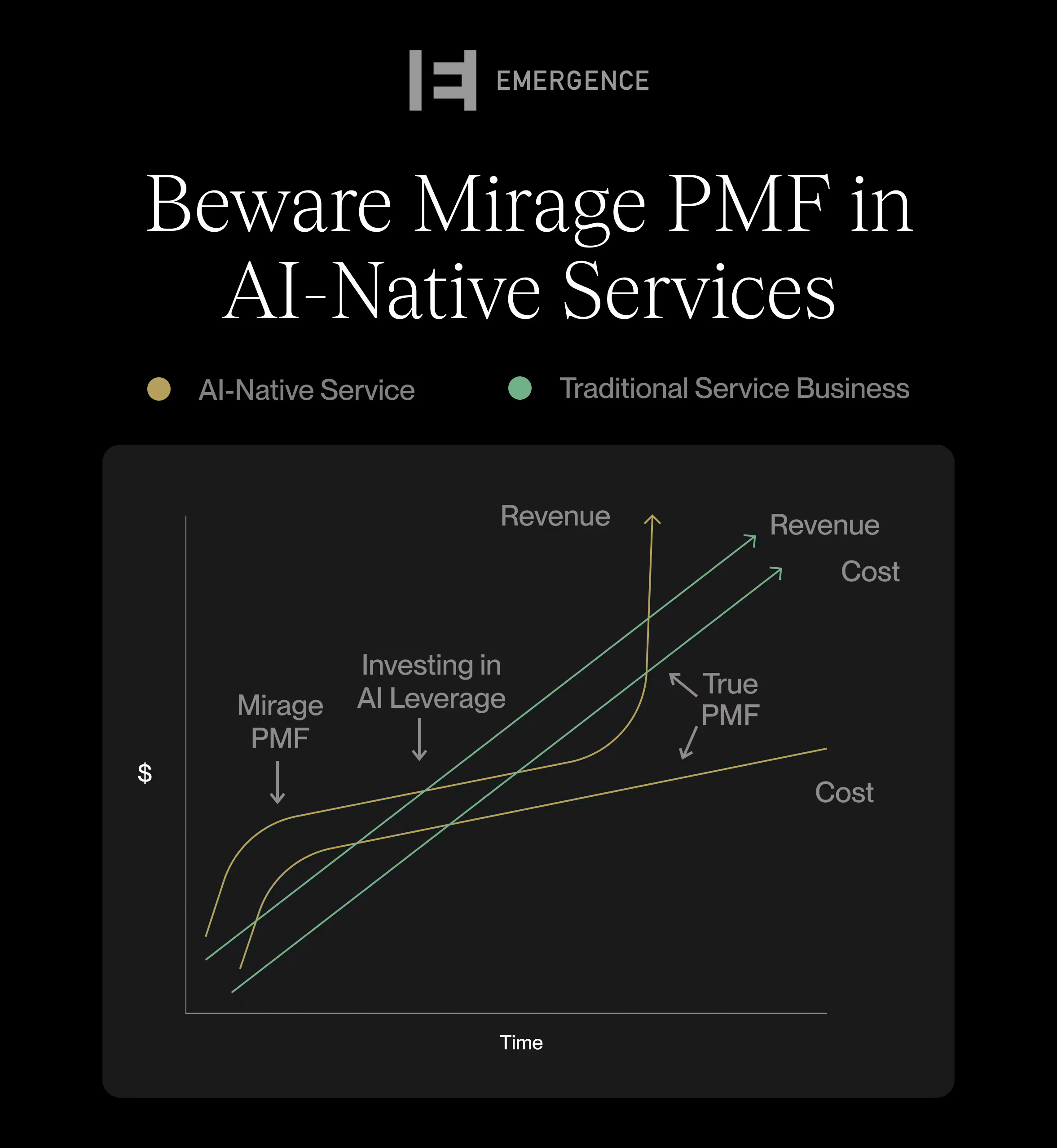
Mirage PMF looks like growth, but the unit economics tell on you:
Declining or flatlining gross margins
ARR/FTE isn’t improving
An over reliance on human output for service delivery
High levels of bespoke work
No improvement in North Star Metric
If any of these are true, you don’t have PMF. You have a services business that happens to use AI, and the market will eventually price you accordingly.
Forward this to a founder who needs better signal.
Thanks for reading! I’d love to hear what you thought about the format. Feel free to hit reply and let me know, I respond to every email.
Abhi